
An unexpected flood in the Sahara desert

An unexpected flood in the Sahara desert
In the autumn 2024 guest blog, Amy Case tells the story of her experience of an unexpected rare flood event in the Sahara desert.
When packing for my trip to Morocco in Summer 2024, I hesitated over whether to bring my raincoat. It seemed absurd, considering the country had been in an official drought for over six years. Morocco’s water reserves are dwindling rapidly, with natural rainfall in the southeast receiving less than 50 mm per year on average (IEA, 2023). In her recent article, "Morocco: Where Has All the Water Gone?" (2024), Alice Morrison highlighted water conservation efforts, including the closure of hammams and car washes. The idea of rain seemed impossible.
That’s why, when the first raindrops fell, I didn’t think much of it. We had been travelling for days, starting in Casablanca in the north, and passing through the arid beauty of southern Morocco, admiring the vast aeolian landforms as we headed toward Merzouga. The Ziz River, which begins in the High Atlas Mountains and winds through the Sahara, was in full spate, offering a rare opportunity to capture footage and photographs for the classroom. It wasn’t until we neared Aoufous, a small town nestled in the Ziz Valley, that the seriousness of the situation began to dawn on us.
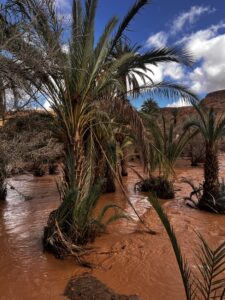
At first, we were amazed by the uncanny sight of what appeared to be a river slicing through the desert, its water murky and red with the sand it carried. But our amazement quickly turned to worry as we realised the N13 road ahead was blocked by an unexpected flash flood. I remember looking around at my companions, wide-eyed and it was clear we were all asking the same silent question: Is this really happening? Is this an actual flood in the Sahara? The geographer in me was filled with curiosity. But as the hours passed, the novelty wore off, and the reality set in. We weren’t going anywhere soon.
As we waited for the floodwaters to subside, a group of local children gathered around our vehicle, their excitement contagious. They greeted us in a lively mix of Arabic, Tamazight, and French, thrilled by the unexpected presence of so many visitors lingering in their town instead of merely passing through. We struck up a conversation with an older man, a French teacher who had spent his entire life in the region. He spoke of the community's gratitude for the rain, explaining that "water is life" here in the desert. He told us how the local apple orchards and the farmers, always at the mercy of nature, were in desperate need of the rare nourishment the rain could provide.
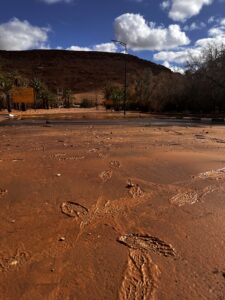
Yet, as we watched the floodwaters surge past, sweeping away branches, rocks, and debris, I couldn’t help but feel conflicted. The rains, a gift of hope to the farmers, had also unleashed undeniable destruction. We had heard whispers that, earlier that day, two travellers had attempted to cross the inundated road, only to lose their lives as their car was carried away by the fierce current. It was a sobering reminder of nature's duality—its ability to nurture and to devastate, often in the same breath.
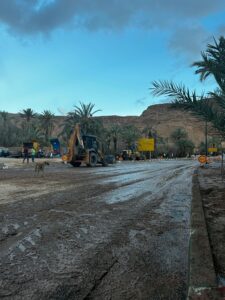
Hours later, the floodwaters finally began to recede, and the Moroccan authorities quickly moved in to clear the road, guiding us through. Just as we picked up speed and thought we were in the clear, night fell, and our vehicle came to a halt in a massive traffic jam. The scene was chaotic, with blaring horns and flashing headlights. We had reached a bridge spanning the still-raging Ziz River. The water was just inches below the bridge, spilling over in places, and the visible cracks in the road made us fear the structure was losing its stability. There was a tense moment as we all had to decide whether it was safe to cross. Despite our concerns, the calm and efficient demeanour of the Moroccan people, along with the steady confidence of our driver, Mohammed, and our guide, Habib, reassured us.
We made the decision and crossed the bridge in silence and as we rolled safely back onto solid ground, a collective sigh of relief filled the vehicle.
The next morning, we woke to a stunning sunrise, with golden light radiating over the towering Erg Chebbi dunes. As we stood there, gazing at the vast, arid landscape, it was almost unbelievable that, just hours earlier, part of the desert had been submerged. The endless sands stretched out in every direction, dry and desolate, as if the rain had never come at all. Yet it had—there had been a flood in the Sahara Desert. It wasn’t a dream.
Nature had reminded us all of its power, its unpredictability. The Earth, it seemed, was desperately seeking equilibrium, throwing extremes our way—floods in deserts, heatwaves in winter. I couldn’t help but wonder what was next. Perhaps a tropical storm in Antarctica? Whatever comes, one thing is clearer to me than ever: we are witnessing the earth’s dynamic response to a world out of balance. This unexpected flood was caused by the warm moist air from towards the equator meeting colder air moving south over the Mediterranean and producing very unstable air, thunderstorms and intense rain. This rare weather pattern resulted in flood waters rushing downstream along riverbeds called Wadis which are usually dry.
All images copyright © - Amy Case
References:
A news report of the 2024 Morocco flash floods can be found here: Flooding kills more than 20 people in Morocco and Algeria | AP News
International Energy Agency (2023) Climate Resilience for Energy Transition in Morocco. https://www.iea.org/reports/climate-resilience-for-energy-transition-in-morocco
Morrison, A (2024) Morocco: where has all the water gone? The Geographer. https://www.rsgs.org/blog/morocco-where-has-all-the-water-gone
About the author:
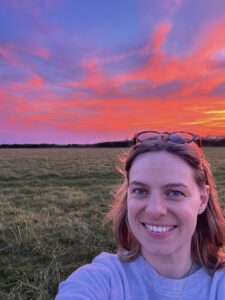 Amy Case, MEd, PGCE, FRGS studied Geography and Environmental Management at the University of the West of England, and is a former Head of Geography and Independent Curriculum Consultant. She recently joined Flooglebinder as their Curriculum Exploration Officer.
Amy uses her teaching background to curate bespoke, sustainable and curriculum aligned study expeditions. A key part of her role is to work with teachers to ensure that their fieldwork and residential trips are fit for purpose and making a genuine impact. Amy is Vice Chair of the GA International Special Interest Group.
Past guest blogs:
Past guest blogs from previous months can be found under "News: categories - past guest blogs", or by following this link https://www.geographysouthwest.co.uk/category/past-guest-blogs/