
Making Space for Sand: GCSE Case Studies
Introduction
The Making Space for Sand project has supported project partners South West Coastal Monitoring and Geography South West to develop a GCSE geography resource pack exploring dynamic coastal landscapes in Cornwall and Devon. Through three detailed case studies, students investigate coastal landforms and different methods of coastal management using real-world examples, maps, aerial imagery, photographs, historical evidence and contemporary data.
The resources provide students with opportunities to develop their understanding of key coastal issues while applying their knowledge to real-world examples. They also support GCSE-style geographical enquiry, interpretation of evidence and revision.
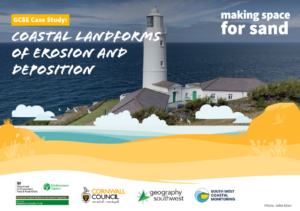
Case Study 1: Coastal landforms of erosion and deposition – Trevose Head, Cornwall
Students explore a range of coastal landforms around Trevose Head, including headlands, bays, caves, stacks, blowholes, wave-cut platforms and beaches. The case study also explores the formation of sand dunes at Constantine Bay and Treyarnon Bay and the effect of beach change on the dunes. Students will investigate the role of waves and how variations in the wave and rock type, alongside the processes responsible for coastal erosion and deposition, have shaped the coastline.
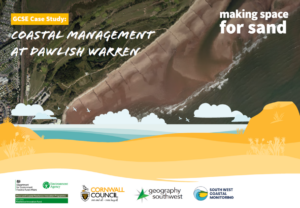
Case Study 2: Coastal management – Dawlish Warren, Devon
Students will learn about the different coastal management approaches and how these have been applied at Dawlish Warren. Students investigate and discuss why Dawlish Warren is an important but vulnerable coastal environment. They will explore the highly dynamic sand spit, environmental threats posed by climate change and sea level rise, and the socio-economic and environmental reasons for managing the area. Students will examine the different approaches used at the site, before evaluating the success of these approaches and considering the long-term future of Dawlish Warren.
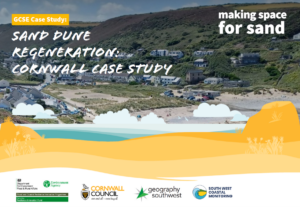
Case Study 3: Sand dune regeneration – Cornwall
Students explore sand dune regeneration as an example of soft engineering and investigate how dunes can be protected, restored and managed. They examine the role of marram grass, fencing, Christmas trees and sand dune notches, using examples from Widemouth Bay, Penhale and Porthtowan, allowing students to investigate how communities and coastal managers are working with natural processes to improve dune resilience, protect coastal communities and enhance biodiversity.
Together, these resources support key GCSE geography curriculum themes including:
- Coastal processes and landforms
- Coastal erosion and deposition
- Coastal management and engineering
- Physical and human factors affecting coastal environments
- Climate change and sea level rise
- Sustainable coastal management
- Geographical enquiry and interpretation of evidence
- Evaluation and decision-making
- Case-study knowledge and revision
The Making Space for Sand Project is funded by Defra as part of the £200 million Flood and Coastal Innovation Programmes which are managed by the Environment Agency. The programmes will drive innovation in flood and coastal resilience and adaptation to a changing climate.
For more information about the project please go to: www.makingspaceforsand.co.uk
Click the links below to download the resources.
Contribute
Our aim is to promote geography and geographical education in the South West of England. Geography SW is a collaborative project driven by a group of enthusiastic geographers who have volunteered their time to create a wide-ranging and dynamic resource to support the wider geographical community.