
SW Geography Conference 2026
Introduction
Welcome to the SW Geography Conference 2026 page! We were very pleased to welcome over 100 delegates, presenters and guests to the 2026 conference on Monday 22 June 2026. The use of the larger lecture rooms and spaces at University of the West of England (UWE) Enterprise Park 1 building worked well, providing many opportunities for chatting to exhibitors and socialising along with a wonderful lecture hall.
We are very grateful of the generosity of UWE, the Geographical Association, the RGS/IBG and our highly valued exhibitors for making this conference a great success.
Presentations from the 2026 Geography Southwest conference where available can be found by clicking on the links in the report below.
Presentations from previous conferences in 2025, 2024, 2023 and 2022 can be found on this website. https://www.geographysouthwest.co.uk/conference/
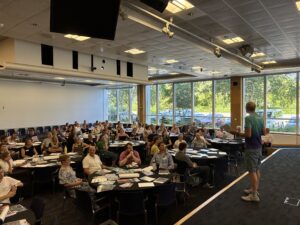
2026 conference summary:
Keynote lectures (click on title to view presentation)
Steve Brace, Chief Executive at the Geographical Association (GA). 'Geography makes a difference‘. Steve provided a timely update on the direction of travel for the new National Curriculum for geography and the implementation timescale for the new National Curriculum, GCSEs and A levels. He also highlighted other areas where geography makes a difference to young peoples’ lives and future careers including highlighting the ten highest earning degrees with geography holding its own amongst the likes of medicine, dentistry, economics, law and engineering.
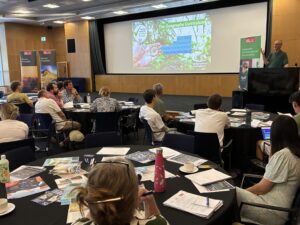
Tim Marshall (Author, 'Prisoners of Geography') 'Inspiring students to study geography'. Tim talked about encouraging students to study geography through places and maps. He showed how maps can bring international relations, history and geography alive, using examples enabling us to see the world from the perspective of different countries finishing with the wise and profound words ‘geography always matters’.
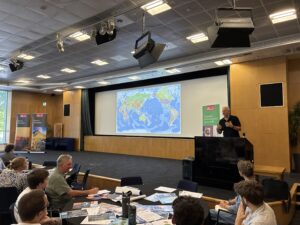
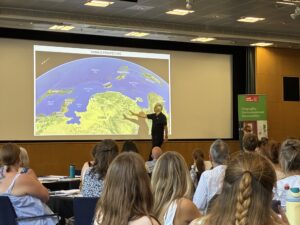
Chris Spencer (UWE) '2023 Syrian/Turkey earthquake'. Chris investigated whether this event was a natural or human disaster by exploring it through a series of stages of the disaster management cycle. At each stage, he examined the reasons why the event was so impactful and what might have been done to negate this.
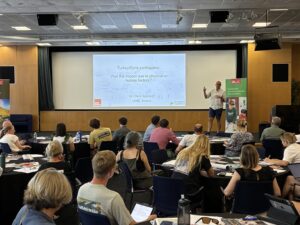
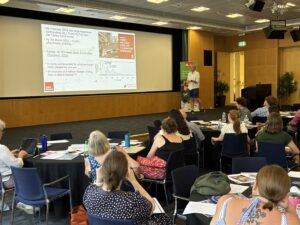
RGS Lecture Dr Becky Collins (University of Bristol) 'Remote sensing: observing the spatial from space' RGS Lecture. Becky's detailed overview showed explained how satellites can help us understand what is happening on Earth often in places we cannot easily reach. Through a series of short case studies on urban expansion in Las Vegas, USA and Dailan, China, wildfire detection in Jasper, Canada and Aral Sea reduction, Becky demonstrated how remote sensing allows geographers to observe landscapes, hazards and environmental change from space. She kindly provided activities and examples for teachers to take back to their schools.
Workshops
Kiaran Ratcliffe (ERSI UK) 'GIS: Taking your skills further. This interactive workshop looked at how to use your own data to create purposeful maps using ArcGIS online, and strategies to source reliable datasets and bring them to life with Map Viewer and Instant Apps.
Catherine Rule (Rayburn Tours) 'Geography - from the classroom to the field and back again' Catherine looked at how international fieldwork can become an integrated part of learning and used pre-recorded interviews to illustrate practical ways of engaging students before the trip, while on fieldwork and through post trip activities.
Karen Corfield (Discover the World Education), Geography of Belonging: Third Places, Communities and Everyday Life. Karen looked at the concept of Third Places and Communities. She used examples from Nordic countries to show how they shape social geographies and ways to embed these ideas into engaging fieldwork and NEA experiences.
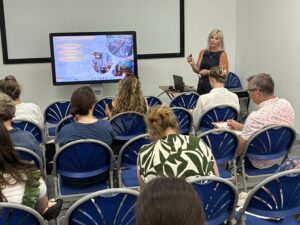
Robyn Landy (FSC) 'Empowering students to be decision makers during fieldwork at GCSE and beyond' Robyn showed ways to encourage students to be more actively involved in decisions on data collection and analysis during fieldwork with creative and practical ideas on how to empower learners to engage critically.
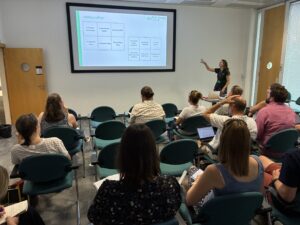
Dr Rosanna Carver (University of Cambridge) 'Geographies of Hope: engaging with ideas of 'hope' and 'hopelessness' in the classroom. Rosanna highlighted how students are increasingly aware of multiple crises, including environmental change and conflict and shared ideas with teachers on how to address these issues. The workshop discussed how we can also encourage young people to imagine alternative possibilities and futures, using creative methods, to see how hopeful understandings of a complex world could be encouraged as a starting point for change.
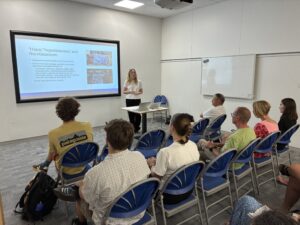
Reuben McQueen and Ibrahim Mizi (OpenKit) 'New developments in AI to support GCSE/A level teaching' This interactive session showed practical ways through which AI can support geography teaching including useful prompt techniques, common pitfalls and examples of how AI tools can fit into everyday classroom workflows.
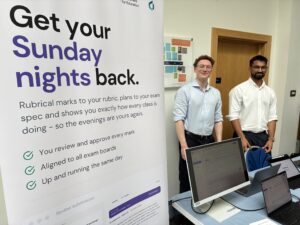
Graeme Schofield (Oak Academy) 'New resources for KS3 and GCSE' Graeme looked at creative ways to adapt geography curriculum resources using the Oak geography curriculum as inspiration and showing how teachers can tailor content to their local area.
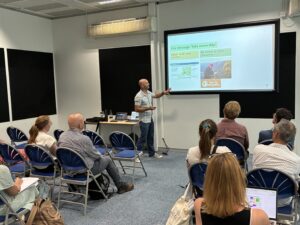
Jolyon Sharpe (Making Space for Sand) 'New resources and latest approaches in coastal management'. Jolyon showed some of the exciting curriculum materials being developed as part of the Making Space for Sand project in Cornwall, including the Coastcraft game and other online resources supporting teaching of depositional coastal landforms.
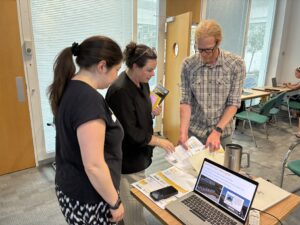
Many thanks to Emma Espley for providing summaries of the lectures and workshops.
Contribute
Our aim is to promote geography and geographical education in the South West of England. Geography SW is a collaborative project driven by a group of enthusiastic geographers who have volunteered their time to create a wide-ranging and dynamic resource to support the wider geographical community.